

D5BRIEFING ROOM · 簡報室HA-CS-0017 MIN
CI202: Nineteen Days of Silence — How the Public Saw the Truth First
On 14 June 2020, a China Airlines A330 landed at Taipei Songshan with all three primary flight-control computers failing near-simultaneously; manual braking stopped the aircraft 9 metres from the runway end. Public reporting appeared 19 days later; the TTSB final report took 15 months. Inside that gap, public data was scarce in kind. This piece argues why ATC tower audio reached the public record faster than the investigation did, and what its specific place is among ADS-B, NOTAM, and DFDR.
TL;DR On 2020-06-14, China Airlines CI202 landed at Taipei Songshan Runway 10 with all three primary flight control computers failing near-simultaneously; manual braking stopped the aircraft 9 meters before the runway end. No public coverage appeared for 19 days. This piece uses the case to examine how ATC audio relates to — and differs from — other categories of public aviation information.
ATIS01
Three categories, only one reveals cockpit intent
The division of labour among public data sources
On 3 July 2020, Taiwanese media first reported an event that had happened three weeks earlier: on the evening of 14 June, a China Airlines Airbus A330 carrying 98 people had landed at Taipei Songshan Airport and lost automatic braking and thrust reversers. The crew stopped the aircraft with manual braking nine metres short of the runway end. All three primary flight control computers had failed almost simultaneously — the only such event across 44.3 million flight hours for that aircraft family[1].
The nineteen-day silence was not a cover-up. Preliminary investigations of major aviation safety events take time; authorities hold back public comment until facts are established. This is standard international practice. The final report would not appear until September 2021, fifteen months after the event.
But for anyone following the story during that window, public data sources were not scarce in principle. The question was — and is — what each category can and cannot say. That shapes how this kind of event gets understood.
ADS-B broadcast data (accessible via Flightradar24, ADS-B Exchange, and others) is real-time, public, and independently verifiable. It records position, altitude, heading, and vertical rate. For CI202, ADS-B showed the aircraft touched down on Runway 10 and stopped far along it. That is the whole signal. Why it stopped there, and what was happening inside the cockpit — ADS-B cannot answer.
NOTAMs and METARs are equally public and queryable, covering operational notices (runway closures, facility changes) and weather observations. They describe the environment surrounding the event, not what happened during the event.
Flight-data and cockpit-voice recorders (DFDR / CVR) are the ground truth of any investigation. They capture hundreds of aircraft parameters and the flight crew’s audio, precise enough to reconstruct any second of flight. Under Annex 13 of the Convention on International Civil Aviation and Taiwan’s Transportation Safety Investigation Act, raw data is available only to the designated investigation authority — here, the TTSB. Until the report is published, no one else can read it.
Air traffic control (ATC) radio is transmitted on open frequencies. Any legal receiver can capture it. What distinguishes it from the others is not publicness — ADS-B and NOTAM share that — but content: ATC is the one category that, in the moment of the event, carries in natural language the pilot’s stated intent and the controller’s real-time judgement. During the fifteen months the DFDR was sealed and authorities were not speaking publicly, ATC audio was the most direct public source for that specific layer.
EVENT02
The event
2020-06-14 · RCSS · Runway 10
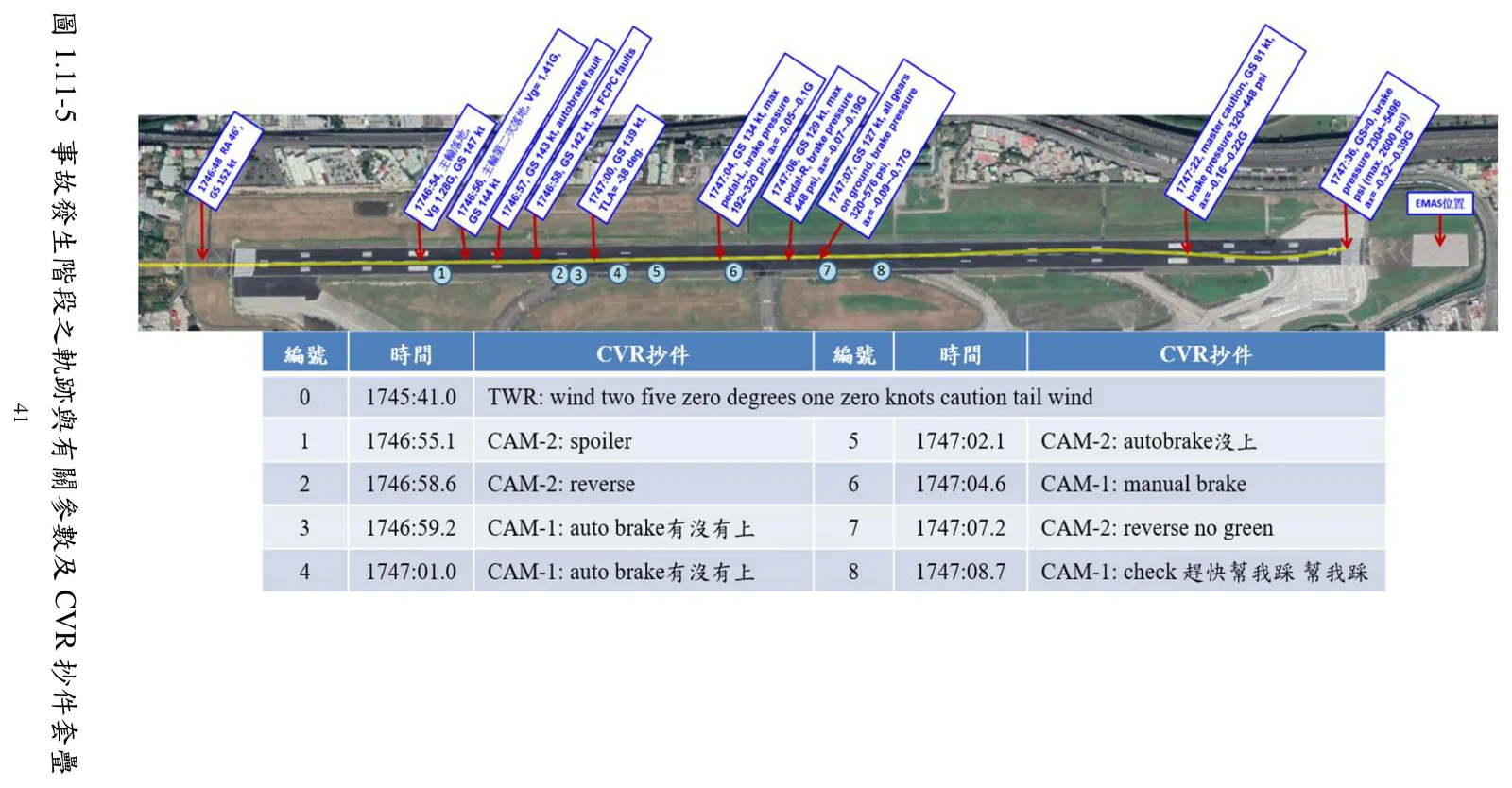
At 17:46:54 Taipei time, Airbus A330-302 B-18302 touched down on Runway 10 at Songshan. Three seconds after touchdown, an autobrake fault signal appeared. At the four-second mark, all three PRIMs failed near-simultaneously; ground spoilers retracted and the thrust reversers never deployed. The crew switched to manual braking at 17:47:04, pedals to the floor; the aircraft came to a complete stop at 17:47:36, nine metres (30 ft) before the RWY 28 end. All 98 people on board (11 crew, 87 passengers) were uninjured.
Beyond the RWY 28 end, an EMAS (Engineered Material Arresting System) measuring 122.2 m × 69.1 m compensates for Songshan’s inability to meet ICAO Annex 14 RESA length standards due to the tight urban site. CI202 stopped within nine metres of the EMAS leading edge, without triggering it.
RECORD03
How the tape reached the public
2020-07-04 release · CAA bulletin +10 days
Media first reported the event on 3 July 2020 (Epoch Times). The next day, we pulled the raw Songshan tower channel recording for the 17:44–17:52 window on 14 June from our archive and ran the following process:
- Audio segmentation (filter by callsign CAL202 / Dynasty 202)
- Manual denoising and segment merging
- Bilingual verbatim transcription (English approach + Chinese tow coordination)
- Timestamp alignment (cross-validated against ADS-B touchdown time)
- Audio + transcript public release
Elapsed from extraction to publication: approximately 24 hours. The CAA’s Aviation Safety Bulletin ASB 109-060/O R1 was issued 10 days later, on 13 July.
Outlets that cited it
Between 3 and 14 July 2020, several Taiwanese outlets drew on the tower recording released on our YouTube channel; only reports we can link to are listed below. That window corresponds to the TTSB’s preliminary investigation and the period before the CAA’s first safety bulletin.
Our data covered only what the public frequency carried — far less than what the TTSB would eventually have from DFDR / CVR. But during the period the DFDR was sealed and the authorities were not speaking, those 4 minutes 38 seconds were one of the first-hand sources that both public media and anyone with a receiver could independently re-verify on the tower frequency.
VALIDATION04
Fifteen months later
TTSB final report vs the tower-frequency content
On 3 September 2021 the TTSB published TTSB-AOR-21-09-001, reconstructing the event from DFDR / CVR — including the parts no one on the tower frequency could have observed (the software trigger conditions for the triple PRIM failure, brake hydraulic pressure curves, the full causal chain). The table below compares only tower-observable facts between the TTSB report and our 2020-07-04 release.
| Tower-observable fact | TTSB Final Report | hungATC 2020-07-04 | Match |
|---|---|---|---|
| Touchdown time | 17:46:54 | transcript timeline aligns | ✓ |
| Clearance wind | 250° / 9 knots | “wind 250 degrees 9 knots” | ✓ |
| Crew’s post-landing report of reverser failure | quoted in report | captured in transcript | ✓ |
| 9-metre stop distance | ~30 ft before RWY 28 end | cited by media on that basis | ✓ |
This is not a claim that an ATC transcript can reconstruct causality — it cannot; that requires DFDR / CVR. The comparison is scoped narrowly to what the tower frequency could have observed. Within that narrower scope, a transcript made by picking up a public radio frequency and typing it out by hand held up against fifteen months of independent, authority-level verification. That is a property worth noting about ATC audio as a category of public information at the tower layer.
CAPABILITY05
Commonly asked
How this differs from adjacent data services
How is this different from Flightradar24 / ADS-B Exchange?
FR24 and ADS-B Exchange record flight tracks — where the aircraft is, how fast it is moving. ATC recordings capture dialogue — what the aircraft is asking for, what the controller is authorising. The two are complementary. For CI202, ADS-B showed the aircraft stopped far along the runway; it was the ATC exchange that revealed operational-level details such as “manual brake” and “reverse not active.”
How is this different from LiveATC.net?
LiveATC streams ATC frequencies worldwide and keeps a best-effort, time-limited archive. It does not provide transcripts, timestamp alignment, or cross-referencing to flight data. Our addition is narrower and more specific: store it, transcribe it, align it against aircraft data, keep it retrievable.
Legal basis?
ATC frequencies are open radio transmissions; any lawful receiving equipment (amateur radio, aviation-band scanners, etc.) can monitor them. What we publish is the transcript and processed audio; identifying information can be redacted on legitimate privacy request from a party named in the recording.
Replicability?
CI202 is reconstructable because our receivers were covering the Songshan tower channel at the time. If they had not been, we could not have gone back to it. That is a real limit of ATC as a public information category: whoever is not listening to the frequency at the moment of the event cannot fill in that gap later. The structural point — and one reason distributed, persistent receiving networks matter for aviation transparency — is that coverage has to exist before the event, not after.
Closing
ADS-B contributes position and speed. NOTAM and METAR contribute environmental context. DFDR and the eventual report deliver full causality. In the gaps between those, the ATC frequency carries the one public channel that records cockpit intent and controller judgement in the moment the event is happening. CI202 is one observation of that category at work.
On CI202, hungATC’s work was concrete: the receivers were running, the audio was stored, and 24 hours after the event entered public view the transcript was out. That recording remains something anyone can replay and independently verify.
Those 4 minutes 38 seconds on the frequency were receivable in the moment, citable afterwards, and able to survive independent cross-check against the TTSB report 15 months later.
Related work
- LiveATC.netLiveATCLiveATC.net。2004 年起運作的全球民間 ATC 頻道 archive 網站;任何人能架站 feed 自己的接收到網站、形成分散式收音網。 Global ATC channel archive since 2004 — upstream infrastructure for this category.
- BellingcatBellingcatBellingcat。2014 年創立的開源情報(OSINT)調查新聞組織,以公開資料 + 公開方法的調查手法著稱。 OSINT investigative journalism. Their editorial standards are the reference for how this piece is structured.
Primary sources
- TTSB-AOR-21-09-001 Taiwan Transportation Safety Board final investigation report, 3 September 2021
- Taiwan CAA Aviation Safety Bulletin No. 109-060/O R1, 13 July 2020
- Epoch Times First-day media coverage, 2020-07-03
- UDN “Landing Emergency — Full 4m 38s Pilot-Tower Dialogue Revealed”
- AIP Taiwan AD 2.14 RCSS — Arresting System (EMAS)
Sources list last updated: 2026-04-23 · Found a factual error or broken link? Write to hi@hungatc.com.
Contact The audio and transcripts from this case are public reference material, freely usable for verification, research, or teaching. For questions or collaboration, reach us at hi@hungatc.com.
References
- TTSB-AOR-21-09-001: Major Transportation Accident Investigation Report — China Airlines CI202 Multi-System Failure on Landing at Songshan Airport — Taiwan Transportation Safety Board, 2021-09-03